
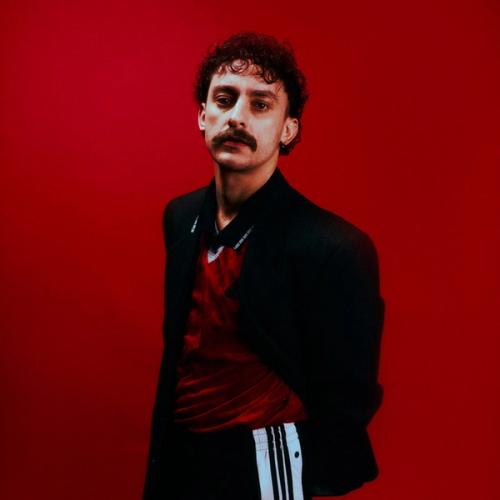


Antony Szmierek first came to Sziget in 2018 as a punter, sneaking off to watch Arctic Monkeys debut Tranquility Base Hotel & Casino material before the record was even out. This year he's back headlining the second stage himself, and the version of him that used to hide in the festival's corners has mellowed considerably. "It is a good site, there's little corners to hide," he says. "We stayed in an Airbnb even then, and I was only like twenty-seven. There's lots of little nooks and crannies and corners, and you can be naughty and hide. It's so dense in the crowd that you can get up to no good." He pauses. "We have to be slightly more sensible now. I've just had a chicken schnitzel and a cup of tea."
That's the register Szmierek operates in more or less constantly: profound one sentence, self-deprecating the next, never staying in either mode long enough to get comfortable. It's the same quality that makes 'Decoding Birdsong' land as hard as it does, and it goes right back to a life before music entirely.
Before any of this, Szmierek was a full-time teacher, working with children with special educational needs, and he didn't leave the classroom in some dramatic exit either. He timed it deliberately for the Christmas holidays, so as not to disrupt the kids he was teaching, and he did it without a record deal in place. In the meantime he was already living a double life. "We did Jools Holland, and I went back to work the next day, and they were like, where have you been?" he laughs. "And I was like, I can't say. This is so weird." Parents picking their kids up would clock him still hanging around after everyone else had clearly moved on. "They'd be like, why are you still here? And I'd be like, well, I ain't got any money."
"We did Jools Holland, and I went back to work the next day, and they were like, where have you been?"
The moment it actually clicked, that this might become a life rather than a hobby, came via his own notes app. "The other day I typed in Glastonbury in my notes app trying to find what set we played, and the first note was a list I couldn't remember writing. It was the list of reasons I was leaving teaching." He runs through it: can't go for a piss, don't see any of your colleagues, stressful, all this sort of stuff. "The last thing on the list was, you can go to Glastonbury again. Meaning that I could go to Glastonbury, because I wouldn't be teaching, because with teaching, you can't book your holidays." He stops for a second. "It made me emotional. I was kind of like, the next time I went, we played ourselves rather than just going back. So whatever that mad note was, maybe it was an eclipse again at the time. I was manifesting and didn't realise it."
Ask if he'd have carried on teaching had music never taken off, and there's no hesitation. "Yeah, I loved it. So probably. I still miss it in a weird way. The show's not far off. It's still me doing a lesson, really." It's a comparison he clearly enjoys pulling on, but underneath the joke sits something closer to a mission statement about who he actually is. "I'd say probably a poet who happens to make dance music," he offers, when pushed on where he sits between the two. "I think it's a Venn diagram of dance music, alternative music, poetry. But I have always written. That's the thing I've always done. I just like electronic music too. I was also really keen to be an indie frontman, so I made sure there were guitars and all that. I want to be Jarvis Cocker. It's all three of those things at the same time."
"I want to be Jarvis Cocker."
That writer's instinct shows up most clearly in how specific he lets himself get. "A really good lesson I've learned is that the really hyper-specific tunes do better," he explains. "People don't want you to dumb it down. I can be talking about Stockport or whatever, and they're not arsed. If it's a good song, it's a good song, and they'll find their own meaning. If you write it well enough, I think that's the way to do it." It's a balancing act he's clearly thought hard about, especially on a record this personal. "It was that thing where you sort of go, do you make things less specific for a broader audience? But what was coming out, I knew was truthful and it was honest, so this is what this record is." There's stuff on 'Decoding Birdsong' he still won't unpack fully. "There's loads of stuff that I actually can't say personal life-wise. But it's kind of in order of what happened to me. In a nice way. No, I'm fine," he promises.
The record wasn't just emotionally difficult to make; some songs fought him on a production level too. 'Seminal' wasn't originally a garage song at all. "It had a piano on it instead. It felt weirdly Underworld-y for a bit," he recalls, before it found its final, spikier shape. 'Aussie Gold Hunters', the album's closer, went through its own transformation: "It was a dancier track for a bit. It's already a sad song, so I wanted to confuse everyone." He talks about album one's tracklist with something close to nostalgia by comparison, singling out 'Rafters' as one of the record's great, underrated cuts, and admitting a genuinely conflicted relationship with one of its best-loved songs. "I hate 'Take Me There'. Not hate, but I struggle with it, although we are playing it tonight because people do really like it. You know when people take pictures of you and you never like pictures of yourself that other people think are good? That's 'Take Me There'. I never loved it because I was trying to do another thing, and it's like three songs glued together. But the show is for other people. I do enjoy doing it live, but it took me a while."
He's sceptical of albums built entirely around their singles too. "The worst thing that happens when an album comes out, you've heard the five best songs and the rest of the shit. It's so annoying." He brings up Get Down Services, whose own album landed the same day as this interview. "It's just eleven singles. They could have released anything."
Bristol, where Szmierek now lives, keeps supplying him with material whether he wants it to or not. "It looks so visually different. It also sounds different. People row past my flat. There was a fucking sea lion in the harbour the other day. Usually it's a shopping trolley or whatever." Told his next album risks becoming entirely about the sea, he laughs it off, but not entirely convincingly. "I am quite scared there's going to be loads of boats on the third album. It's going to keep going on about boats or whatever." He's genuinely unsure what that third record looks like yet, only that it probably won't sound like this one. "I'm in a place now where I really like the second record. I want to feel a bit more comfortable after this one, and maybe not be in such a rush to do another one. Maybe a quieter record, maybe not as dancey. I don't know. That's the excitement. I don't know what's going to happen."
Some of that uncertainty came from a genuinely difficult stretch while writing 'Decoding Birdsong', one he's remarkably open about. "I was quite lonely, and all of those mythologising tendencies did start to fire back in on myself, and I was going, this is actually fucking me up. I'm crying on stage all the time because I'm trying to give everyone this really beautiful show, but then I can't stop crying all week. I'm an open nerve and everything's making me cry. Not in a sad way, just that I was so emotional. It was as if I'd just had a baby."
Fame, or whatever the dance-poetry equivalent of fame looks like, has changed how he relates to people he used to only admire from a distance. "I was hanging out with Fcukers today. I think a year ago I would have been like, shit, I love that record, and I want to speak to them, but I don't know them. You just embrace it. I feel like a little stick going downstream." At Sziget, he'd spent part of the day watching Lewis Capaldi, an artist who's almost his mirror opposite: a very funny person who can sound sad, where Szmierek is a sad person who can sound very funny. Told as much, he doesn't disagree. "That's a really good observation. We do have a similar stage patter. You're right, we're kindred spirits but we're opposites. Maybe we'd fit together. Maybe we'll be best friends. I'd like a Capaldi hug."
For anyone coming to Szmierek fresh off the back of this record, he's got a ready-made pair of recommendations, one from each end of his catalogue. "You have to have one banger and one sad one. I don't think I exist without both of them." His picks: 'Restless Leg Syndrome' from the debut, as the sad one, and 'Seminal' from the new record, as the banger. "It says stupid things, like putting suncream on a statue but not having the guts to tell her. What does that mean? Who knows. I just say stuff, and that's what it's all about."
'Decoding Birdsong' is out now.


